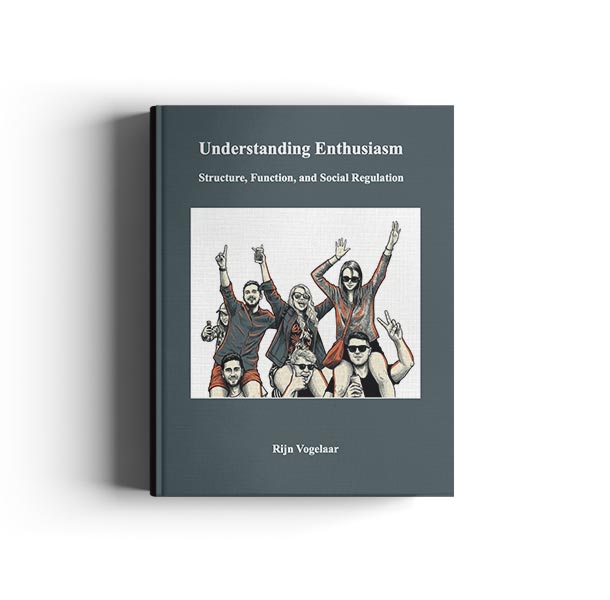
Understanding Enthusiasm
Structure, Function, and Social Regulation
This dissertation examines enthusiasm as a distinct psychological emotion. Although widely recognized in everyday life, enthusiasm has received little systematic attention in psychological research. The dissertation first situates enthusiasm within its historical and philosophical context, before examining the concept through three empirical studie
The findings show that enthusiasm is a positive, high-energy emotion that is directed at attainable goals and often involves interaction with others. It differs from related emotions such as joy and hope by its strong focus on action and engagement. Across cultures, people tend to experience enthusiasm more often in situations where it is considered appropriate, with clear differences between private life, work, and public settings.
The dissertation integrates these insights into a definition of enthusiasm and discusses its role in emotion theory, its social and motivational functions, and its relevance for domains such as education, organizations, leadership, consumer behavior, and politics.
The dissertation is available for free digital download. If you would like to receive a printed copy, please send a message via the contact form on this website. Printed copies are available for €20, excluding shipping costs. Please indicate whether you would like to receive the English version or the Dutch translation, and include the preferred shipping address. Payment information will then be provided.
Propositions
- Enthusiasm is a positive, energetic, and goal-directed emotion with a clear social component. (This dissertation)
- Enthusiasm is distinct from joy or hope. (This dissertation)
- How enthusiasm is experienced depends on context and cultural background. (This dissertation)
- When enthusiasm is normatively imposed by work, commerce, or social media, it loses its authenticity. (This dissertation)
- Enthusiasm loses its strength and may lead to emotional exhaustion when it is not authentic.
- Enthusiasm in itself is neither good nor bad; its value depends on the purpose for which it is used.
- Enthusiasm works like a magnet: it attracts people and makes them magnetic in turn. (after Socrates)
- A poet cannot compose until he has been enthused and carried beyond himself. (after Socrates)
- Without enthusiasm we die a little. (after Honoré de Balzac)
- The slowness of the scientific publication process undermines researchers’ enthusiasm.
- Should the author, after obtaining his doctorate, happen to make an imprudent remark, this should be attributed not to incompetence but to enthusiasm.
- Enthusiasm makes life worth living.